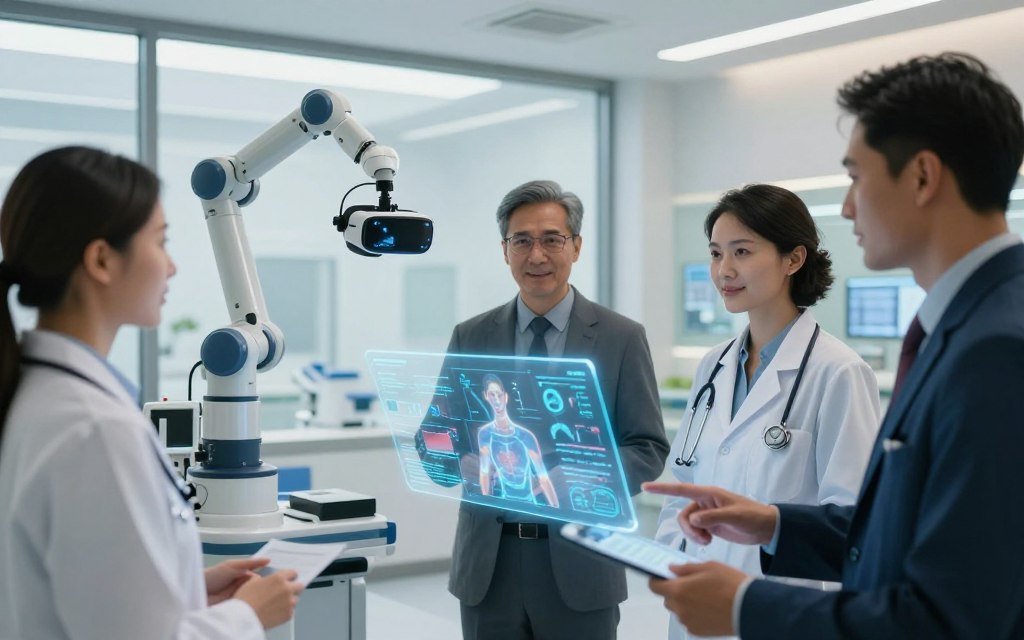

AI and healthcare professionals are working together on ai health to improve diagnosis, treatment, and patient care. This partnership is reshaping US healthcare technology, making care more efficient and personal. Artificial intelligence in healthcare supports physicians, nurses, and other providers instead of replacing their expertise.
Human clinical judgment and machine intelligence can improve patient outcomes when they work together. AI analyzes data faster, supporting timely action and care plans for individual patient needs. Healthcare teams must address patient privacy, algorithmic bias, and transparency in AI applications.
This article explores AI and healthcare professionals, including the benefits and limits of technology in health services. Understanding these issues shows how this partnership is transforming the healthcare industry.
Key Takeaways
- AI enhances the capabilities of healthcare professionals.
- Collaboration leads to improved patient outcomes.
- Data analysis is faster with AI support.
- Personalized care is a key benefit of AI integration.
- Concerns about privacy and bias must be addressed.
1. The Growing Role of AI in Modern US Healthcare
Artificial intelligence (AI) is becoming essential to healthcare in the United States. As technology advances, healthcare AI systems are entering more healthcare processes. These systems aim to improve patient care, clinical outcomes, and daily operations.
Understanding AI’s role means examining its definitions, applications, and teamwork with healthcare professionals.
Defining AI in the Healthcare Context
AI in healthcare includes technologies that analyze complex medical data. These technologies include:
- Machine Learning: Algorithms that learn from data to make predictions or decisions.
- Natural Language Processing: Systems that understand and interpret human language.
- Computer Vision: AI that processes and interprets visual information from the world.
- Generative AI: Models that can create new content based on learned patterns.
- Predictive Analytics: Techniques that use historical data to forecast future outcomes.
These healthcare AI systems can identify patterns in medical records, images, laboratory results, and wearable-device data. Machine learning in medicine helps providers use these patterns to improve diagnoses and personalize treatment plans.
The Shift Toward Technology-Enabled Patient Care
Healthcare is shifting toward technology-enabled patient care. This transition includes:
- Electronic Health Records (EHRs) that streamline patient information.
- Telehealth services that provide remote consultations.
- Remote monitoring tools that track patient health metrics.
- Automated documentation systems that reduce administrative burdens.
- Digital clinical decision support systems that aid healthcare professionals in making informed decisions.
This shift creates more efficient workflows and better patient experiences. AI can process vast amounts of data, but it lacks a licensed professional’s full context, empathy, and ethical reasoning.
Why Collaboration Matters More Than Replacement
Collaboration between AI systems and healthcare professionals is crucial. AI analyzes data quickly, but providers interpret recommendations, speak with patients, and consider personal circumstances. As healthcare technology expert Dr. John Halamka states:
“AI is not here to replace doctors but to augment their capabilities and enhance patient care.”
This view highlights the importance of human-AI collaboration. Together, AI and healthcare professionals can support better clinical decisions while keeping human care central.
2. Why Healthcare Professionals Are Working Together on AI Health
AI health collaboration is becoming essential as healthcare professionals work with artificial intelligence (AI). This partnership combines human knowledge with machine intelligence to improve patient care.
Healthcare professionals guide AI development. They identify clinical problems, choose training data, and check whether results are safe and useful. This teamwork creates AI health solutions that are innovative, relevant, and practical.
2.1. Bridging Clinical Expertise With Machine Intelligence
Combining clinical expertise and AI can support better decisions. Healthcare professionals understand patient needs that AI alone cannot grasp. Together, they can:
- Ensure AI systems are designed to address real-world challenges.
- Facilitate the integration of AI tools into daily clinical workflows.
- Enhance the accuracy of AI predictions by providing context and insights.
This partnership helps create trustworthy healthcare AI systems that clinicians can rely on.
2.2. Reducing Physician Burnout Through Smart Automation
A key benefit of AI is its potential to reduce physician burnout. Many healthcare professionals face heavy administrative work that takes time from patient care. Physician burnout technology can reduce this burden through smart automation:
- Drafting clinical notes efficiently.
- Coordinating appointments seamlessly.
- Managing inboxes and coding support.
- Retrieving information quickly and accurately.
By automating repetitive tasks, healthcare professionals can focus more on patients and less on paperwork. This can improve job satisfaction and patient outcomes.
2.3. Building Trust Between Clinicians and AI Systems
Trust is essential for successful AI use in healthcare. Clinicians need confidence in AI recommendations. This trust can grow through:
- Clear and understandable AI recommendations.
- Reliable performance and consistent results.
- Appropriate training for clinicians on AI tools.
- Defined escalation procedures for when AI outputs are questionable.
- The ability to override AI decisions when necessary.
When healthcare professionals can question and use AI systems, both sides support better patient care.
In conclusion, AI collaboration in healthcare is a shared responsibility. Clinicians, technology teams, health systems, patients, and regulators must create effective, safe, and trustworthy AI health solutions. For more insights on AI’s impact in healthcare, check out this resource.
3. Key Areas Where AI Enhances Clinical Decision-Making
AI tools are becoming essential for informed clinical decisions. AI clinical decision-making gives clinicians useful insights that improve patient care. By analyzing data in real time, AI supports decisions during patient visits. It also lets healthcare professionals focus on high-quality care instead of sorting disconnected data sources manually.
3.1. Real-Time Data Analysis at the Point of Care
One major benefit of AI in healthcare is real-time patient data analysis. Clinicians can instantly view vital signs, medication histories, laboratory results, imaging findings, and clinical notes. This complete view helps them spot clinically important changes and act quickly. These timely interventions can improve patient outcomes.
3.2. Predictive Analytics for Risk Stratification
AI also plays a key role in predictive analytics in healthcare. AI systems can identify patients at higher risk for sepsis, hospital readmission, or medication complications by analyzing historical data. This proactive approach helps providers prioritize care and use resources effectively. It can reduce adverse events.
3.3. Clinical Decision Support Systems in US Hospitals
Clinical decision support systems (CDSS) use AI to help healthcare professionals. They show alerts, summarize patient records, and suggest possible considerations. An alert is not a diagnosis, and too many poorly designed alerts can cause alert fatigue.
Successful CDSS integration requires validation and careful outcome monitoring. It should also improve workflow integration.
In summary, AI improves clinical decision-making through real-time data analysis, predictive analytics, and advanced clinical decision support. These tools support efficient, effective patient care in US healthcare settings.
4. How AI Supports Diagnostics and Early Disease Detection
Artificial Intelligence (AI) is changing healthcare diagnostics. These AI diagnostics support early disease detection. Advanced algorithms find patterns in medical data that human experts may miss. This skill matters in radiology and pathology, where fast, accurate diagnoses can improve patient outcomes.
4.1. AI-Powered Medical Imaging and Radiology
In AI medical imaging, tools help radiologists prioritize urgent scans and spot suspicious findings. For example, AI systems analyze images for signs of diseases such as cancer. They compare images over time, helping doctors track disease progression.
Radiologists still provide the final interpretation of reports. AI acts as a powerful ally, improving diagnosis while human experts make final decisions.
4.2. Pathology and Laboratory Diagnostics
AI also supports digital pathology and laboratory diagnostics. Automated slide analysis can classify cells and check sample quality. This technology helps pathologists interpret complex laboratory data more efficiently.
AI can streamline workflows by reducing time spent on manual reviews. This lets healthcare professionals focus on patient care. However, clinicians must thoroughly evaluate AI findings to confirm their accuracy.
4.3. Early Detection of Chronic and Rare Diseases
Early detection helps manage chronic and rare diseases, especially when symptoms appear subtly across several encounters. AI combines data from different sources to identify at-risk patients sooner.
For example, AI can review patient histories and lab results to flag health issues before they become critical. This proactive approach can improve condition management and patient outcomes.
However, AI systems need rigorous testing across diverse patient populations. This reduces false positives and negatives and supports fair diagnostic quality across all demographics.

5. AI’s Role in Personalized Treatment Plans and Patient Care
Artificial Intelligence (AI) is changing how healthcare providers create personalized treatment plans. By studying large amounts of data, AI can build individualized treatment plans for each patient. This tailored care can improve treatment results and help patients receive suitable care.
AI systems use age, medical history, diagnoses, medications, laboratory findings, lifestyle, treatment responses, and patient preferences. Clinicians can compare treatments, spot medication interactions, and estimate likely responses by combining these details. This process changes care plans over time, making AI a valuable modern healthcare tool.
5.1. Tailoring Therapies to Individual Patient Profiles
Personalized medicine AI creates treatment plans designed for individual patients. It considers genetic factors that can strongly affect responses to some medications. Providers can use these differences to choose effective therapies, reduce harmful effects, and increase benefits.
5.2. Genomics and Precision Medicine in the United States
Genomics and precision medicine lead personalized healthcare in the United States. Genetic information helps assess risks and develop targeted therapies. Pharmacogenomics studies how genes affect drug responses, supporting precise medication choices.
However, this sensitive information needs careful interpretation and strict privacy protections to protect patient confidentiality.
5.3. Continuous Monitoring Through Wearable AI Devices
Wearable AI health devices continuously monitor vital signs, including heart rate, glucose levels, sleep patterns, and activity levels. These devices collect real-time data that can help manage chronic conditions and improve overall health outcomes. To work well, their data must be clinically relevant, accurate, and securely transmitted.
These devices offer useful insights, but patients still need meaningful conversations with healthcare providers. Too much reliance on automated recommendations can overload users with data and weaken patient-provider relationships. Patient consent and digital access are vital for adding these technologies to everyday care.
6. Improving Patient Outcomes Through Human-AI Collaboration
Human-AI collaboration is changing healthcare and improving patient outcomes. By linking patient outcomes and AI in clinical workflows, professionals can make better decisions and provide better care. It also addresses current challenges and supports a more efficient healthcare system.
Reducing Medical Errors and Diagnostic Delays
A key benefit of AI in healthcare is reducing medical errors and diagnostic delays. AI systems can flag drug interactions, find abnormal lab results, and support accurate records. These tools help providers make informed choices and give timely, suitable care.
For instance, a study found that AI can reduce diagnostic delays by giving faster access to relevant patient information. This helps clinicians prioritize urgent cases while preserving a thorough clinical examination. The result is higher-quality care and better patient outcomes.
Enhancing Patient Engagement and Adherence
Patient engagement technology helps patients follow their treatment plans. Personalized reminders, conversational AI tools, and plain-language resources help patients take an active role in care. Accessible, culturally appropriate technology improves their experience and supports adherence to prescribed therapies.
Remote monitoring solutions help providers track patient progress and keep care plans on schedule. Supported and informed patients engage more, which can improve health outcomes.
Measurable Improvements in US Healthcare Facilities
The effects of AI in US healthcare facilities can be measured through several patient outcome metrics. These include:
| Metric | Before AI Implementation | After AI Implementation |
|---|---|---|
| Diagnostic Turnaround Time | 48 hours | 24 hours |
| Readmission Rates | 15% | 10% |
| Medication Errors | 8% | 3% |
| Patient Experience Score | 75% | 85% |
These metrics show major gains after AI integration. However, teams must assess benefits and unintended effects. Adoption numbers alone may not show the full picture.
“AI in healthcare is not about replacing human expertise; it’s about enhancing it to achieve better patient outcomes.”
Healthcare professionals and AI systems are becoming a powerful team for improving patient outcomes. By reducing medical errors, strengthening patient engagement, and measuring progress, this partnership may reshape healthcare’s future.
7. Challenges and Ethical Considerations in AI Healthcare Integration
AI technologies keep advancing, but healthcare faces serious challenges during ethical integration. These issues include data privacy and algorithmic bias in healthcare, which can affect patient care and trust in AI systems.
Data privacy and HIPAA rules are major concerns for providers. Providers must collect, store, transmit, and process protected health information (PHI) safely to support HIPAA compliance. They need consent and strong cybersecurity, while large training datasets and third-party vendors complicate privacy, access, and control.
Data Privacy and HIPAA Compliance Concerns
Healthcare organizations must minimize data collection and use strict access controls to protect sensitive information. They must balance comprehensive training data with patient privacy. HIPAA and artificial intelligence make this harder because AI needs useful data without exposing patients.
A leading expert stated:
“The ethical use of AI in healthcare hinges on our ability to protect patient data while leveraging its power for better outcomes.”
Algorithmic Bias and Health Equity Issues
Another critical issue is algorithmic bias in healthcare, which can create unequal access and treatment. If AI systems use non-representative data, underrepresented populations may receive less accurate predictions or unequal access to AI-supported care. To combat this, it is essential to:
- Utilize representative data sets
- Conduct subgroup performance testing
- Implement ongoing monitoring of AI systems
- Maintain transparent documentation
- Establish mechanisms for reporting harm
Regulatory Oversight by the FDA and Other US Agencies
The FDA, other US agencies, state regulators, and professional bodies help govern AI in healthcare. FDA AI regulation does not eliminate local validation or clinical oversight. Continuous post-deployment evaluation checks whether systems work as intended and avoid unintended patient harm.
In conclusion, responsible AI integration requires addressing these challenges. Our focus must remain on patient safety, fairness, and accountability. For more insights on AI in healthcare, visit this link.
8. The Future of AI and Healthcare Professionals Working Together
AI and healthcare professionals will shape the future of medical practice. Emerging healthcare technology is changing clinical work and improving patient care. As AI advances, integrated AI healthcare systems will support teamwork between human experts and technology.
Emerging Technologies Reshaping Clinical Workflows
Ambient clinical documentation, multimodal AI, and advanced remote monitoring are leading this change. These tools give providers more time for patient interaction and reduce administrative work. For instance, generative AI assistants can simplify documentation and support patient care.
Digital twins and interoperable data platforms will improve real-time decisions. They give clinicians complete patient data, improving diagnosis accuracy and supporting personalized treatment plans for each patient.
Training the Next Generation of AI-Literate Clinicians
As AI grows common in healthcare, the next generation of AI-literate healthcare professionals must understand its use. They should interpret performance metrics, recognize AI limits, protect patient data, and identify algorithmic bias. Training must also teach them to communicate uncertainty clearly.
Medical schools and continuing professional development programs should provide interdisciplinary training for future clinicians. Practical AI evaluations can build their ability to use sound clinical judgment in real-world situations and work alongside AI technologies.
Long-Term Vision for Integrated AI-Healthcare Systems
The long-term goal for integrated AI healthcare systems is to strengthen, not replace, human accountability and clinical independence. Coordinated care will let technology manage analytical and administrative tasks while professionals lead complex decisions and build patient relationships.
Patient choice and access will remain central, supporting equity across diverse populations. The best future will not fully automate healthcare; it will unite AI and professionals to improve patient care.
“Technology is best when it brings people together.”
In conclusion, the future of AI in healthcare could greatly improve patient outcomes and operational efficiency. By training AI-literate healthcare professionals and using emerging healthcare technology, we can build an innovative, compassionate healthcare system.
For more insights on AI’s impact on healthcare, visit this article.
9. Conclusion
Collaboration between AI and healthcare professionals marks a major step toward better patient care. The AI and healthcare future looks promising, with benefits of healthcare AI that can reshape medical care. Faster analysis and earlier disease detection support treatment plans tailored to each person’s needs.
Healthcare systems now have more efficient workflows and stronger patient engagement. These gains support clinical decisions and help professionals focus on care, while privacy, cybersecurity, and algorithmic bias need attention. Responsible AI health innovation needs transparency and regulatory oversight to support fair access.
AI should strengthen healthcare professionals’ skills, not replace them. Empathy, communication, and accountability remain vital during patient interactions. Together, they can create a healthcare environment that prioritizes patient-centered artificial intelligence for safer, more effective outcomes.


 By
By